
Buy Canadian: How Much Are Consumers Willing to Pay for Canadian Potato Chips?
-
A choice experiment with 501 Canadians shows who will pay more for Canadian chips, how much, and what brands should do about it.
Authors: Eric Guntermann (Empirical Intelligence) & Eugene Y. Chan (GCBI)
-
A Choice Experiment, Not a Survey Question
Asking people whether they would pay more for Canadian products tends to flatter the answer. So instead of asking directly, we put 501 Canadians through a choice-based conjoint: a series of realistic shopping decisions between potato chips that differed in brand, price, where the potatoes were grown and where the chips were made.
Respondents were Canadians who had purchased, or intended to purchase, potato chips. They were recruited through Cint Exchange on October 13–14, 2026, with quotas for age, gender, education and region. We then estimated willingness to pay with a hierarchical Bayes market simulator, across five brands: Lay’s, Miss Vickie’s, Ruffles, President’s Choice, and Compliments.
Because every respondent had to trade price against origin, the results show how much of a price increase Canadian origin can absorb, not just whether people say they like it.
-
Fully Canadian Products Have a Clear Demand Advantage
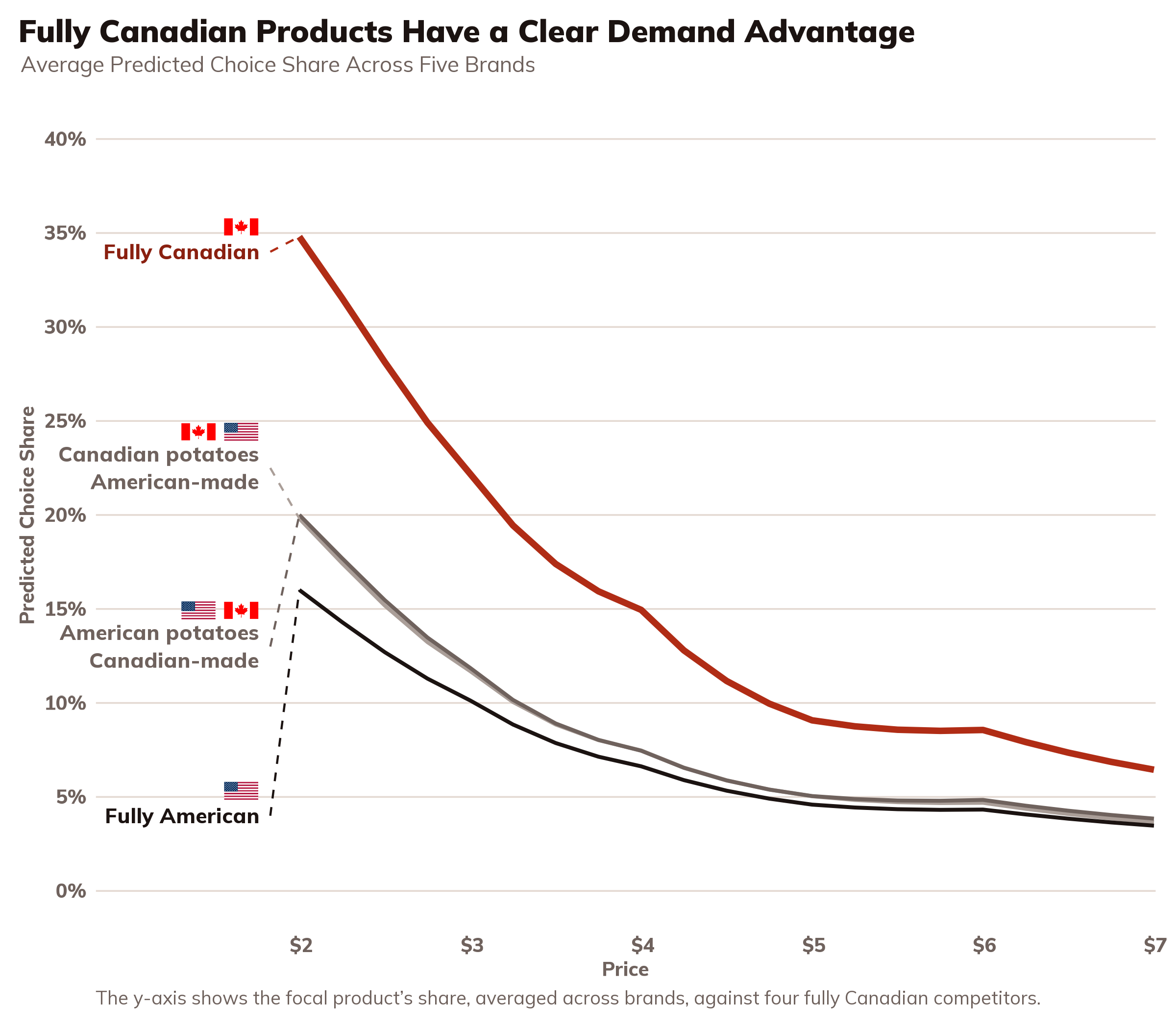
We asked 501 Canadians to choose between potato chips that varied in brand, price, where the potatoes were grown and where the chips were made. The chart shows the share of choices each type of chip wins at different prices, averaged across five brands.
A fully Canadian chip captures far more choice share than any alternative at every price point. What matters most is the line between fully Canadian products and products that are American in any way: chips that are only partly Canadian look much more like fully American chips than like fully Canadian ones.
The practical reading: an origin claim that is only partly true earns little. Canadians appear to treat American potatoes or American manufacturing as disqualifying, not as a small deduction from an otherwise Canadian product. The vertical axis shows the focal product’s share, averaged across brands, against four fully Canadian competitors.
-
The Premium for Canadian Potatoes Is Broad, and Age Matters Most
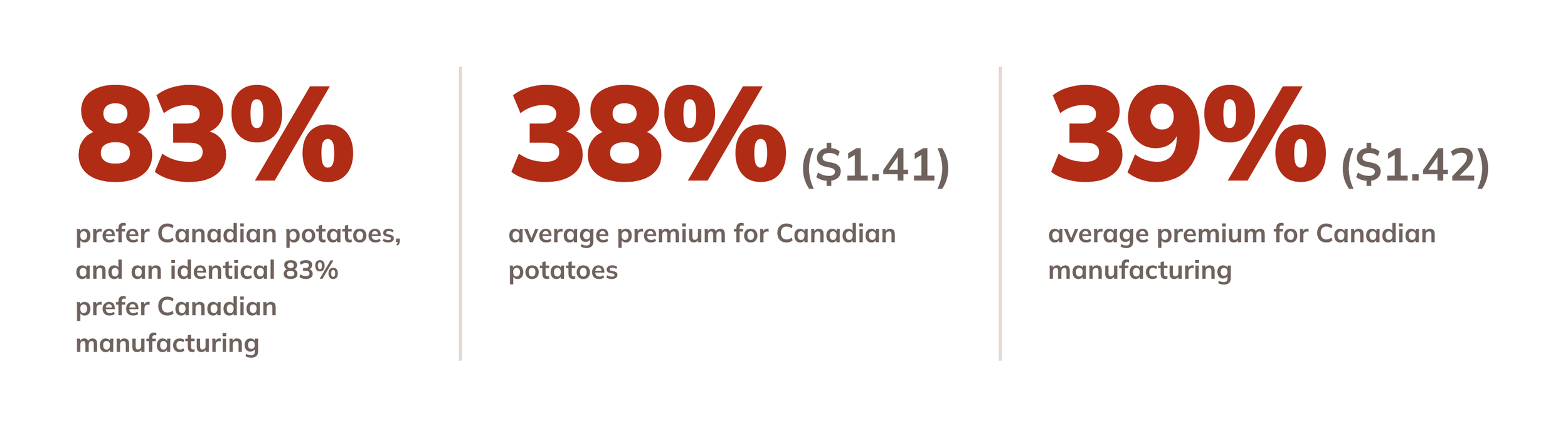
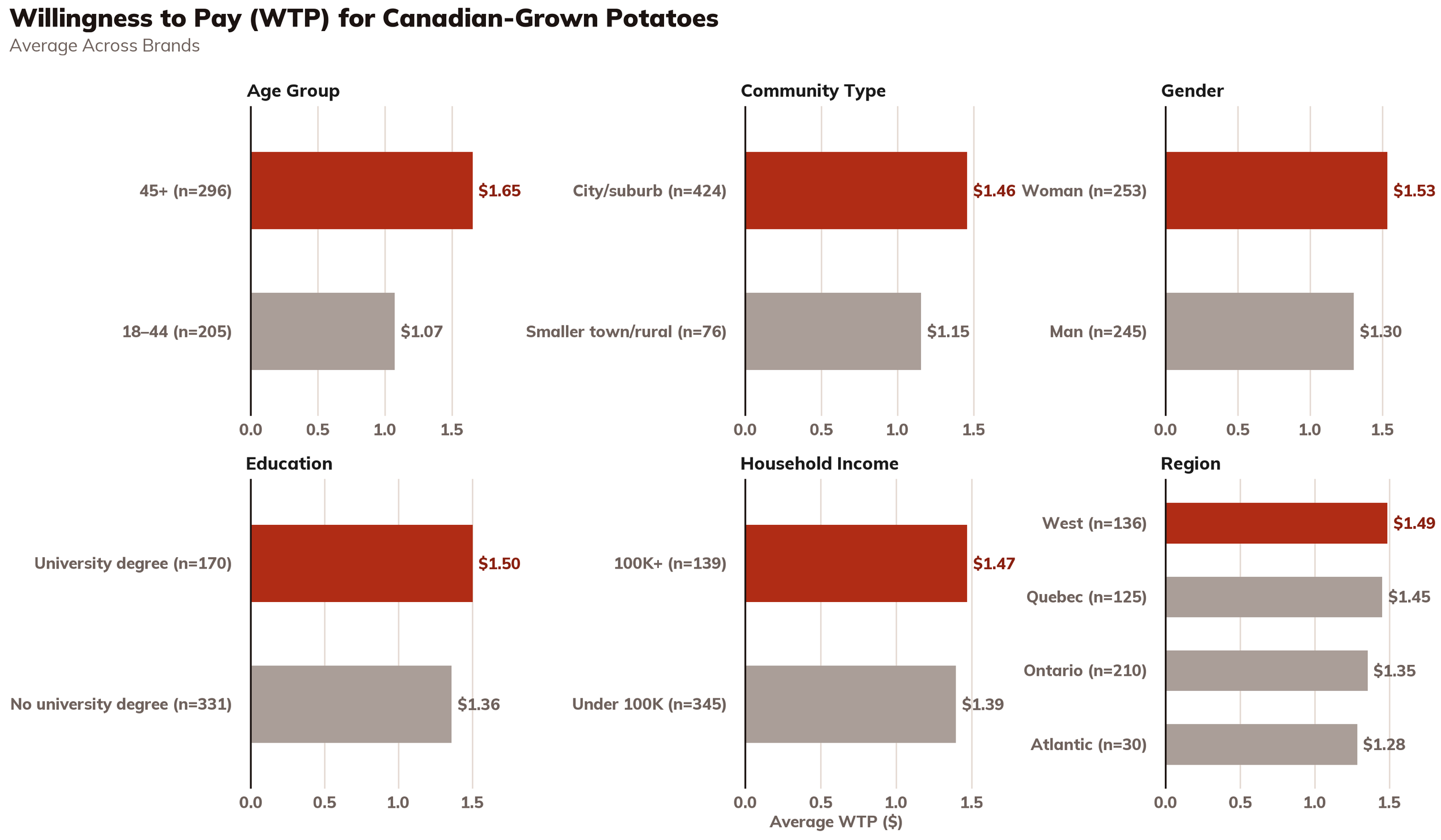
On average, Canadians would pay an extra $1.41 for chips made from Canadian potatoes. The premium is not confined to one kind of shopper, but it varies in ways brands can use.
Age matters most: Canadians 45 and over would pay $1.65 more, against $1.07 for those under 45. Women ($1.53), university graduates ($1.50) and city and suburban residents ($1.46) also pay more than men, those without a degree and smaller-town or rural residents. Household income barely moves the premium ($1.47 for $100K and over, $1.39 for under $100K).
Region adds a smaller layer. Willingness to pay for Canadian potatoes is highest in Western Canada ($1.49) and lowest in Atlantic Canada ($1.28). Atlantic Canada and smaller towns and rural areas are small groups in this sample (30 and 76 respondents), so we would treat those comparisons as indicative.
-
Canadian Manufacturing Shows the Same Pattern
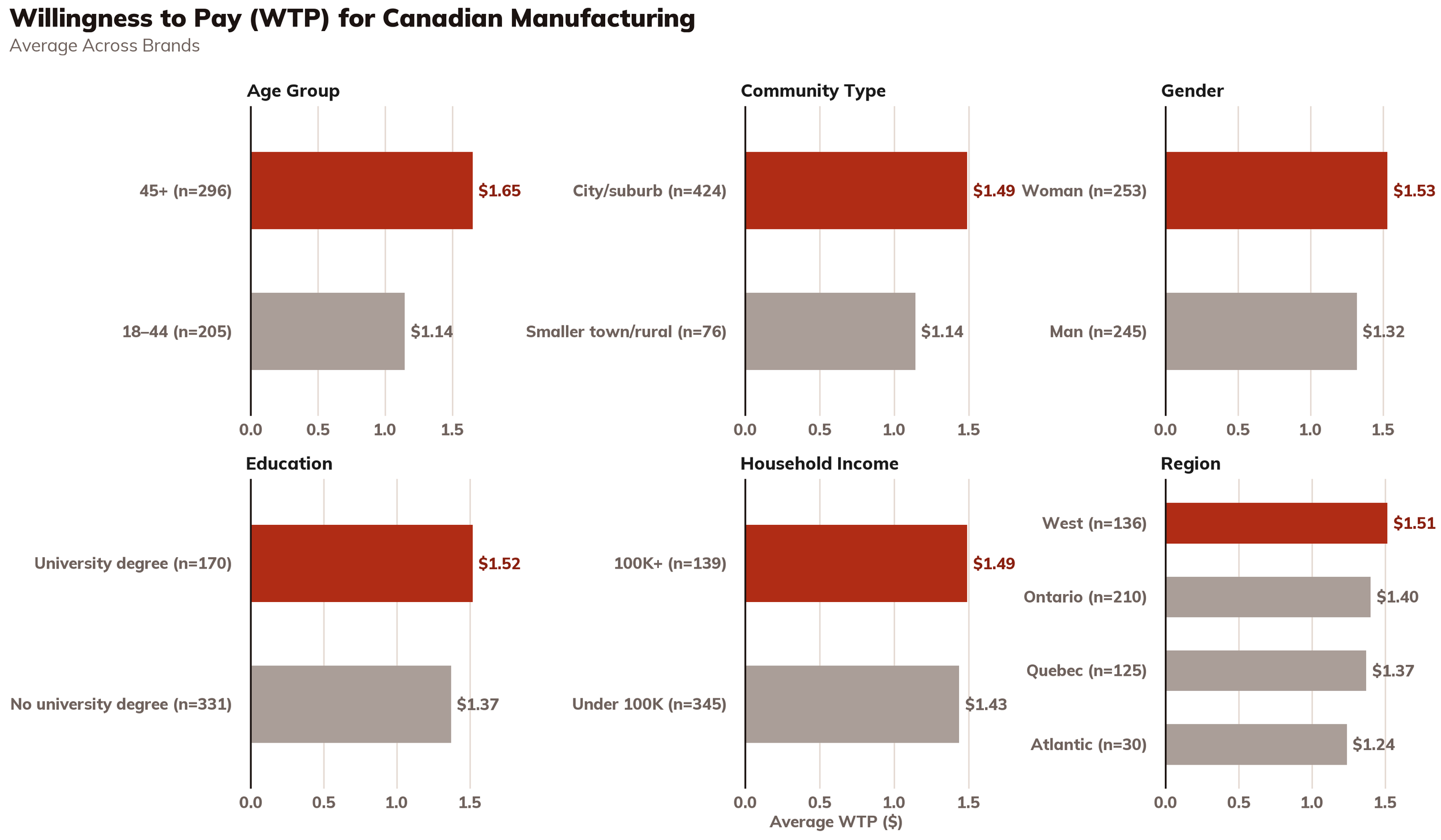
Canadians would pay an extra $1.42, on average, for chips that are made in Canada. The demographic pattern closely mirrors the one for Canadian potatoes.
Again, age separates shoppers most: $1.65 for those 45 and over against $1.14 for those under 45. City and suburban residents ($1.49), women ($1.53) and university graduates ($1.52) pay more, and willingness to pay is highest in Western Canada ($1.51) and lowest in Atlantic Canada ($1.24). The income gap is small: $1.49 for households earning $100K and over, against $1.43 for the rest.
Taken together, Figures 2 and 3 describe the same shopper. The people most willing to pay for Canadian origin are not defined by how much they earn. They are defined by age and, to a lesser extent, by gender, education and where they live, which makes the appeal broad enough to matter for mainstream brands.
-
Canadian Origin Is Worth Real Money, but Only When It Is Fully Canadian
Across the five brands tested, the premium for Canadian potatoes ranged from 31% to 44% of the baseline price, and the premium for Canadian manufacturing from 35% to 44%. It was not confined to higher-priced brands: even the lowest-priced brand earned a meaningful premium.
By brand, the Canadian-potato premium was 44% for Lay’s ($3.25), 39% for Miss Vickie’s ($4.79), 38% for Ruffles ($4.79), 37% for President’s Choice ($3.00) and 31% for Compliments ($2.49). The Canadian-manufacturing premium was 44%, 40%, 38%, 38% and 35% for the same brands.
The gap between fully Canadian and partly Canadian is the main commercial finding. Willingness to pay for Canadian potatoes falls from $1.41 to $0.36 if the chips are made in the United States, and for Canadian manufacturing from $1.42 to $0.43 if the potatoes are American.
Why would income matter so little? One interpretation is that origin preference works as an expression of identity and values, not as a luxury attribute, which is consistent with research on consumer ethnocentrism and country-of-origin effects. The premium is also small in absolute terms, because it applies to a bag of chips and not a high-ticket purchase, so budget constraints may bind less than they would in other categories.
Because income barely moves the premium, this is a broad-market appeal, not a luxury one. For brands, the implication is to offer fully Canadian products when possible. Brands selling American-linked chips can cut prices to offset weaker demand, but that lowers the revenue earned on every unit sold. These are stated preferences from an experiment, so they show where demand sits, not what any one brand can charge.